If you’re curious about Reiki, you’ve probably wondered: Is it spiritual? Is it religious? These questions are common, especially for beginners or anyone considering Reiki Level 1 training. Reiki, a hands-on healing system founded in Japan by Dr. Mikao Usui in 1922, often sparks these questions because it includes symbols, meditation, attunements, and practices that might look “religious” from the outside.
The truth is, Reiki is neither a religion nor a set of beliefs you have to adopt. It’s a practice—a gentle, experiential path that helps you connect with yourself, your energy, and the world around you. In this post, we’ll explore how Reiki can be a spiritual path without being a religious practice, who it’s for, what you need to believe (or not), and why so many people find it both healing and empowering. Whether you’re skeptical, curious, or simply looking for a Reiki for beginners guide, this post will help you understand Reiki from a clear, practical perspective.
Usui Reiki, a system of energy healing that originated in Japan in 1922, offers a spiritual practice for those who are interested in awakening and finding balance in mind and body. While a few elements of the practice were probably inspired by religions, Usui Reiki is far from a religion. It is a path that is rooted in mindfulness, self-awakening, and empowerment.
No. Reiki is not a religion. To answer this simply, it helps to look at what a religion actually is.
A religion usually involves an organized belief system—things like worship, doctrine, sacred texts, moral rules, or devotion to a specific deity or higher power. It asks people to believe certain things and to practice in specific, prescribed ways.
Reiki doesn’t work like that.
Reiki is not a religion because it doesn’t ask you to believe in anything at all. There’s no worship, no prayers you have to say, no rules to follow, and no belief system to adopt. You don’t have to change your faith, question your religion, or consider yourself “spiritual” to practice Reiki.
At its core, Reiki is a practice, something you do, not something you must believe in. People from many different backgrounds practice Reiki comfortably, including those who are religious, spiritual, agnostic, or not spiritual at all.
Some people describe Reiki as a spiritual experience, but that’s about personal experience, not religion. Reiki doesn’t define what you should believe about God, the universe, or life.
Simply put: Reiki is a practice, not a religion. It can exist alongside any belief system—or none at all.
Spirituality means different things to different people, but at its core, it’s about connection—connection to yourself, to something greater than you, and to life as it’s happening. Unlike religion, spirituality isn’t usually about rules or beliefs. It’s more about awareness, presence, meaning, and inner growth.
In that sense, yes—Reiki can be a spiritual practice for those who allow it to be.
Many people experience Reiki as a way to deepen their relationship with their inner world and with the energy of Reiki itself. The word Reiki is often translated as universal healing intelligence or spiritual life force energy. Sometimes described simply, it is the energy of love and light.
Because Reiki includes practices like mindfulness, hands-on healing, meditation, the Reiki Precepts, symbols, mantras, and attunements, it naturally offers many pathways for spiritual exploration. These tools aren’t about belief; they’re invitations to slow down, listen inwardly, and become more present.
For some, Reiki becomes a spiritual path. For others, it’s a healing practice that supports their spirituality in quiet, personal ways. And for many, it’s both.
No—there isn’t anything you must believe in to practice Reiki. You aren’t pledging to a belief system or becoming indoctrinated into any particular set of ideas. Instead, Reiki invites you to explore the connection between your mind and body, develop self-awareness, and notice how your energy influences everything you do and experience.
While Reiki doesn’t require belief, there are shared understandings within the tradition that can help illuminate what this system points toward. Many Reiki practitioners meditate, contemplate, and gradually learn to live into the Reiki Precepts. Dr. Mikao Usui, the founder of Reiki, shared these as The Secret Art of Inviting Happiness and Spiritual Medicine for All Illnesses—not as rules, but as guidance for living.
The Precepts are traditionally shared in Japanese:

The Precepts are not something you’re expected to live into the moment you take Reiki Level 1. They are meant to be understood, contemplated, related to, and practiced over time. This is a moment-by-moment choice, rather than an unrealistic pressure we place on ourselves.
Beyond the Precepts, many Reiki practitioners and teachers aim to live into presence, compassion, a beginner’s mind, and ongoing soul growth. These qualities aren’t forced, but they often arise naturally as a Reiki practice deepens.
Yes—Reiki can be practiced alongside any religion, or with no religion at all. You can be Hindu, Buddhist, Christian, Muslim, Jewish, atheist, or somewhere in between and still practice Reiki. The system of Reiki doesn’t ask you to put your beliefs aside or replace them with something new.
In fact, many people find that Reiki deepens their existing faith. Reiki can support greater awareness, intuition, and sensitivity to life.
In my own experience as a Reiki Master Teacher, practicing since 2015, Reiki helped me come into a deeper understanding of God. Through learning Reiki and developing a steady practice, I began to experience my connection to other realms and dimensions, and to understand my purpose as a human being connected to both Heaven and Earth.
Reiki helped me experience that there is no separation—that I am connected to all of life, both here on Earth and with higher energies. As I came to understand energy, religion felt more approachable and less complicated. I no longer experienced God as a distant figure who grants wishes or punishes, but as the felt presence of Divine love.
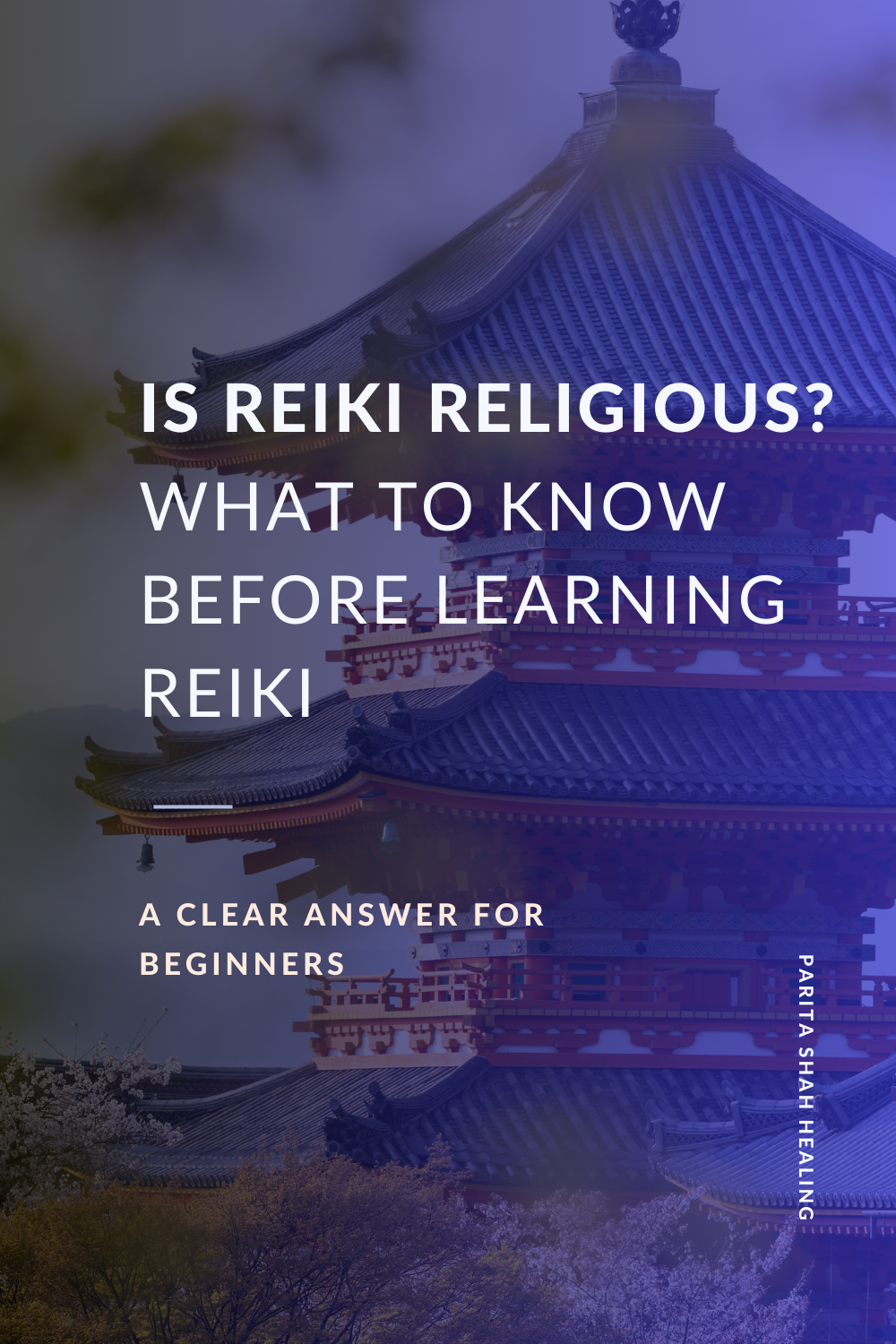
Reiki was founded in Japan by Dr. Mikao Usui (1865–1926), a seeker who spent much of his life studying spiritual and healing practices. He trained in meditation, Buddhist teachings, and other spiritual traditions, exploring ways to cultivate mindfulness, awareness, and connection to life energy (ki). His studies reflected the spiritual culture of early 20th-century Japan, where Buddhism and Shinto coexisted and personal spiritual exploration was common.
In 1922, after years of study, and meditation, Usui went on a retreat on Mount Kurama, a sacred site near Kyoto. There, he experienced a profound awakening that revealed the principles of Reiki—a method for healing and balancing the body, mind, and spirit. He went on to teach this system, blending hands-on healing, meditation, and mindful awareness into a practice that could be learned and shared widely.

Reiki is sometimes misunderstood as a religious practice, and it’s easy to see why. Some of its symbols are inspired by Buddhism, and some people associate chanting mantras with religion. In Usui Reiki, however, chanting isn’t about belief or worship—it’s a tool for developing focus and connecting more deeply with the meaning of the symbols and the energy of Reiki. There is nothing you have to believe to practice Reiki. You don’t even have to invoke the symbols or mantras to practice Reiki.
Dr. Mikao Usui himself was a monk who studied various spiritual and meditative practices, which influenced the system he developed. Because of this background, some elements of Reiki—like meditation, attunements, and working with energy—can look similar to religious practices, but their purpose is very different.
In short, while Reiki borrows inspiration from spiritual traditions, it is a practice, not a religion. Its tools—symbols, mantras, attunements, meditation, and energy work—are designed to help us become more aware, present, and connected, without requiring belief or adherence to any religious system.
Reiki is for anyone who is spiritually curious, open-minded, and willing to explore a deeper relationship with themselves and the Universe. It’s for people who are ready to experience energy firsthand, observe how it shows up in their life, and then allow their beliefs to evolve naturally.
Reiki is suitable for people of all ages—men, women, children, and the elderly—who want to empower themselves to heal from the inside out. This can include healing on many levels: physical, mental, emotional, and spiritual. Reiki can support challenges like anxiety, depression, aches and pains, or feelings of grief, anger, and loneliness. It’s a gentle, non-judgmental way to cultivate balance, presence, and self-care.
That said, Reiki may not be the best fit for those who hold rigid religious beliefs that conflict with the open, experiential nature of energy work. Because Reiki encourages exploration and personal experience, it works best for those willing to engage with it openly and allow their own understanding to unfold.
In short, Reiki is a practice of personal growth, self-awareness, and inner healing that is accessible to nearly anyone who is ready to meet it with curiosity and openness.
No—you don’t have to believe in chakras to practice Reiki. Chakra healing comes from ancient Indian traditions and can be a wonderful complement to Reiki, but it’s not required. You don’t need to channel Reiki to your chakras to benefit from it. Reiki works on many levels, and you can practice it fully even if you have no interest in or belief about chakras.
Similarly, you don’t need to already believe in energy to get started with Reiki. In fact, Reiki is often best learned through experience first. I encourage students to take a Level 1 Reiki course or receive a Reiki session so they can form their own understanding over time. The sensations, shifts, and insights you experience in class or during a session will help you develop your own beliefs about energy naturally.

There’s no pressure to define or solidify your beliefs before you’ve even tried Reiki. The practice itself allows you to explore and come to your own understanding. Reiki meets you where you are, whether you’re skeptical, curious, or simply open to trying something new.
Reiki is a practice that meets you where you are. It doesn’t ask you to adopt a belief system, follow rules, or change your faith. Instead, it offers tools—hands-on healing, meditation, attunements, symbols, mantras, mindfulness, and reflection—that support self-awareness, balance, and personal growth.
Whether you’re drawn to Reiki for healing, personal exploration, or spiritual connection, it can be adapted to your needs and beliefs. You don’t have to understand everything, believe in energy, or even meditate perfectly to benefit. Reiki simply invites you to slow down, pay attention to your own energy, and nurture yourself from the inside out. At its heart, Reiki is about connection: to yourself, to others, and to life itself. It’s gentle, non-judgmental, and accessible to anyone willing to explore, no matter where they are on their journey.


Parita intuitively connects with clients around the world to share reiki and chakra balancing. In a 60 minute call, you can discuss and clear energetic blocks that may be holding you back from physical, mental, emotional and spiritual wellbeing. Allow her to support you in awakening to your true light.